All the world’s a stage – Biggest ever FIFA World Cup set to showcase record £15bn of playing talent
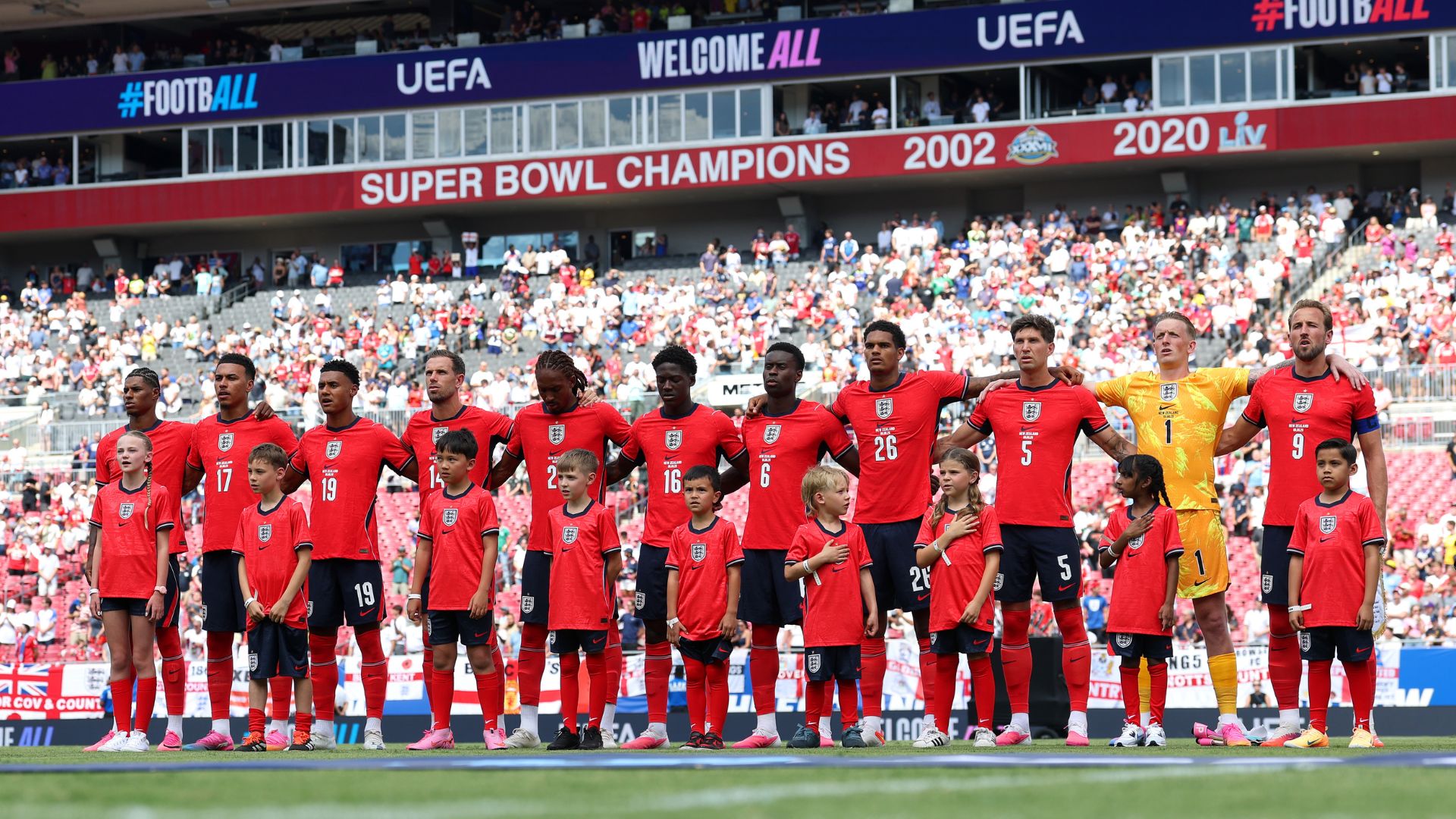
As club shirts are swapped for those adorning the Three Lions, and the faint sounds of ‘Sweet Caroline’ begin to echo on both sides of the Atlantic, World Cup fever is hotting up. France and Spain are bookmakers’ favourites to win the 2026 World Cup based on past performance, strength and key players. But could Tuchel’s team finally take us to World Cup success, ending sixty years of hurt?!
Through collation of over 1,200 player values using data from Transfermarkt.co.uk, UCFB’s Football Finance experts, Claire O’Neill and Christopher Winn, have mapped out their predicted path to victory, based on squad market value.
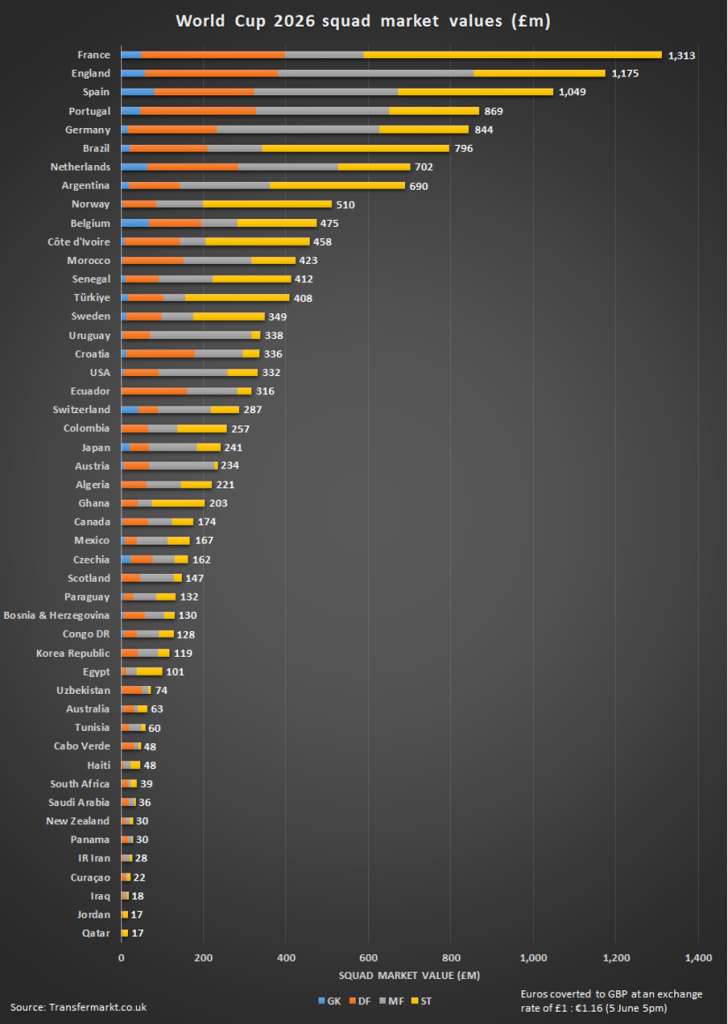
With a record 48 teams taking part across 104 matches, £15bn of playing talent is on show at the 2026 World Cup with 24% of that (£3.5bn) concentrated across just 3 teams.
France, England and Spain boast the highest value squads, each over £1bn, with France top at £1.3bn, being a 26% increase on their Euro 2024 team. With a stacked squad of strikers worth £724m alone, France is set to field three of the top 10 most valuable players on the world stage including Mbappe (£155m), Olise (£129m) and Doue (£103m).
England (£1.2bn) is a close contender, fielding talent including Bellingham (£112m) and Rice (£103m) in the tournament’s most valuable midfield of £475m. However, Tuchel’s choice of squad for the World Cup has seen an 8% fall in value of that on show on the European stage in 2024. Let’s hope that strategy triumphs over value in the race for football’s ultimate prize in this instance!
Spain (£1bn) may take third place in the ranking, but claim joint top spot with Norway for showcasing the two most valuable players in the contest. Barcelona’s 18 year old Lamine Yamal is currently estimated at £172m; greater than the total of the seven lowest value squads combined. Man City’s Haaland, representing Norway, is also estimated at £172m, equating to 34% of the total Norwegian squad value on show.
In terms of concentration of value, the top five squads equate to 35% (£5.3bn) of total value and are all from Europe. Brazil takes 6th place in the ranking with Real Madrid’s Vinicius Junior (£121m) being their star striker and joint sixth most valuable player in the tournament.
The top 12 most valuable players amount to 10% of the overall market value on show in the contest and all play for European clubs, demonstrating the power and allure of the European club elite. Indeed, eight of these players are evenly split between Champions League winners Paris Saint-Germain (£474m) and Real Madrid (£491m).
Although Europe’s influence is further evidenced by contributing 60% (£9bn) of the tournament’s total squad market value, the World Cup remains a genuinely global spectacle. South America accounts for 17% (£2.5bn), Africa 14% (£2.1bn), North / Central America 5%(£774m), Asia 4% (£550m) and 1% (£93m) from Oceania, demonstrating the global spread of footballing talent.
87% (£13bn) of total squad value in the contest is concentrated in half of the 48 competing nations, with the other half – including World Cup debutants Cabo Verde, Curaçao, Jordan and Uzbekistan – carrying a combined squad value of just under £2bn. Jordan and Qatar would appear the likeliest of underdogs, sharing the lowest value squads on show at just £17m each.
Predictions were made of the outcomes through to the finals, where squad market value wins throughout. This was first applied to the group stages so as to determine finishing positions (as well as the eight qualifying third-placed teams), before applying the resulting outcomes to FIFA’s knock-out round matrix and countries’ subsequent placements in the Round of 32.
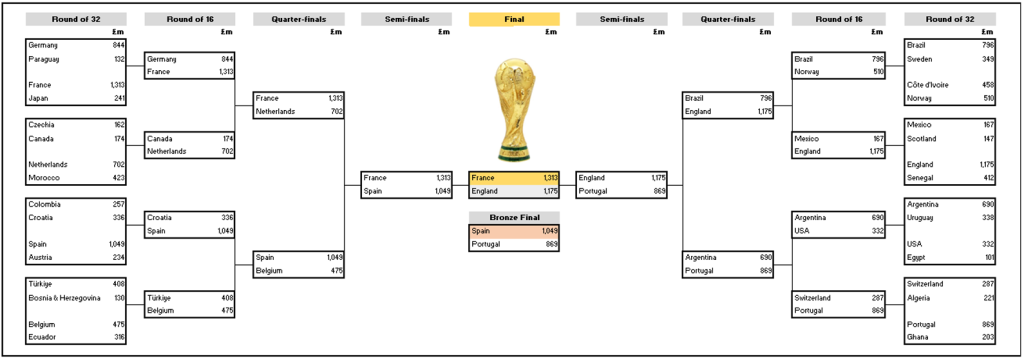
Focusing on the quarter-finals onwards, squad market value would suggest England would edge past Brazil at this stage. However with five World Cup titles to their name Brazil may defy expectations. Could experience prove more valuable than value when it matters most? Three times winning Argentina also bring experience, and based on value are predicted to face Portugal in the quarter-finals. But with Cristiano Ronaldo set to play his sixth and final World Cup, Portugal possess more than just squad value. The prospect of their captain finally lifting football’s greatest prize may provide added motivation and propel them into a Portugal – England semi-final.
Despite placing only 10th in the squad value rankings, Belgium’s £475m squad are predicted to reach the quarter finals, only to face Spain’s £1bn squad, where Rudi Garcia will be placing his faith in De Bruyne, Doku and Courtois if the Red Devils are to pull off a giant-killing upset.
Meanwhile, tournament heavyweights France are predicted to face the Netherlands in the quarter-finals based on squad market value. But with a squad valued at 87% more than their Dutch counterparts, Les Bleus are predicted to advance, leading to a headline semi-final against Spain.
The MetLife Stadium, New Jersey may well be ringing to the sounds of ‘Allez Les Bleus’ versus ‘Eng-er-land’ on 19 July if squad market value prevails and a France -England final is realised. However, it may not be ‘so good, so good, so good’ for England fans, given that in line with bookmakers’ odds, squad market valuations point towards France lifting the FIFA World Cup Trophy.
Commenting on the wider implications of the tournament, Christopher Winn, Senior Lecturer in Football Finance stated, “With a record number of games and teams for a World Cup, so too come record revenue expectations, with FIFA forecasting to generate just under £10bn across the four-year cycle concluding with this summer’s competition, around two-thirds of which will come from the World Cup tournament itself. Significant growth is forecast across all three traditional revenue streams when compared to Qatar 2022, with matchday and hospitality of particular note. A much larger geographical market, combined with a much larger number of games, has led to matchday revenue projections of c.£2.25bn- more than three times the matchday revenue generated four years ago. However, with FIFA’s ticket pricing strategies facing criticism and even investigation for excessively high price points and a lack of clarity, it remains to be seen just how well attended some games in the tournament will be.”
“With record revenues coming in, the prize money for the tournament has increased by more than 50% since Qatar 2022. Teams exiting the tournament at the Group Stage stand to receive c.£7.5m each, with amounts increasing in the knock-out rounds all the way up to c.£37.5m for the World Cup winners. All teams also receive c£1.9m in ‘preparation costs’, meaning all nations stand to receive a minimum c.£9.4m for their participation this summer. Despite these figures, some countries have expressed concerns that the cost of travel and operations across such a vast geography may actually result in a net cost to their participation.”
Claire O’Neill, Senior Lecturer in Football Finance added, “Whilst all eyes will be on the USA, Canada and Mexico for the next five and a half weeks, the World Cup comes at a time of regulatory change for Premier League clubs back home. The 2026/27 season will mark a shift from the three-year profit-focused Profitability and Sustainability Rules (PSR) to the more player-expenditure focused seasonal Squad Cost Ratio (SCR), aligning with an element of UEFA’s Financial Sustainability Regulations.”
“In practice, this will mean Premier League clubs are limited in what they can spend seasonally on player and head coach wages, amortisation of player contracts and agent fees to 85% of applicable revenues and profits on player sales. As a result, an element of the ability to invest in new playing talent this summer will be more directly linked to a club’s ability to generate profits from player sales than ever before. With c.165 Premier League players called up for World Cup duty (13% of all players selected), the shop window now goes both ways to a greater extent, with clubs not only looking to strengthen off the back of strong World Cup performances but also sell at a post-tournament premium to operate within SCR constraints. All the world is now very much a stage.”
Claire O’Neill is Course Leader for BA (Hons) Football Business and Finance, Manchester campus. To find out more about our BA (Hons) Football Business and Finance course, or other undergraduate degree courses on offer, click here.
Christopher Winn is Course Leader for MSc Football Business. To find out more about our MSc Football Business course, or other postgraduate degree courses on offer, click here.


You may also be interested in

Guest Speakers
September 1, 2026 |
The Role of AI in Sports Media: Innovation, Efficiency and the Human Touch
Read Post
Guest Speakers
April 21, 2026 |
Quickfire Questions with Ellen White
Read Post

Alumni
June 17, 2025 |
Where Are They Now: Sam Smith – senior media coordinator at IMG Media – Premier League Productions
Read Post
Our Partners